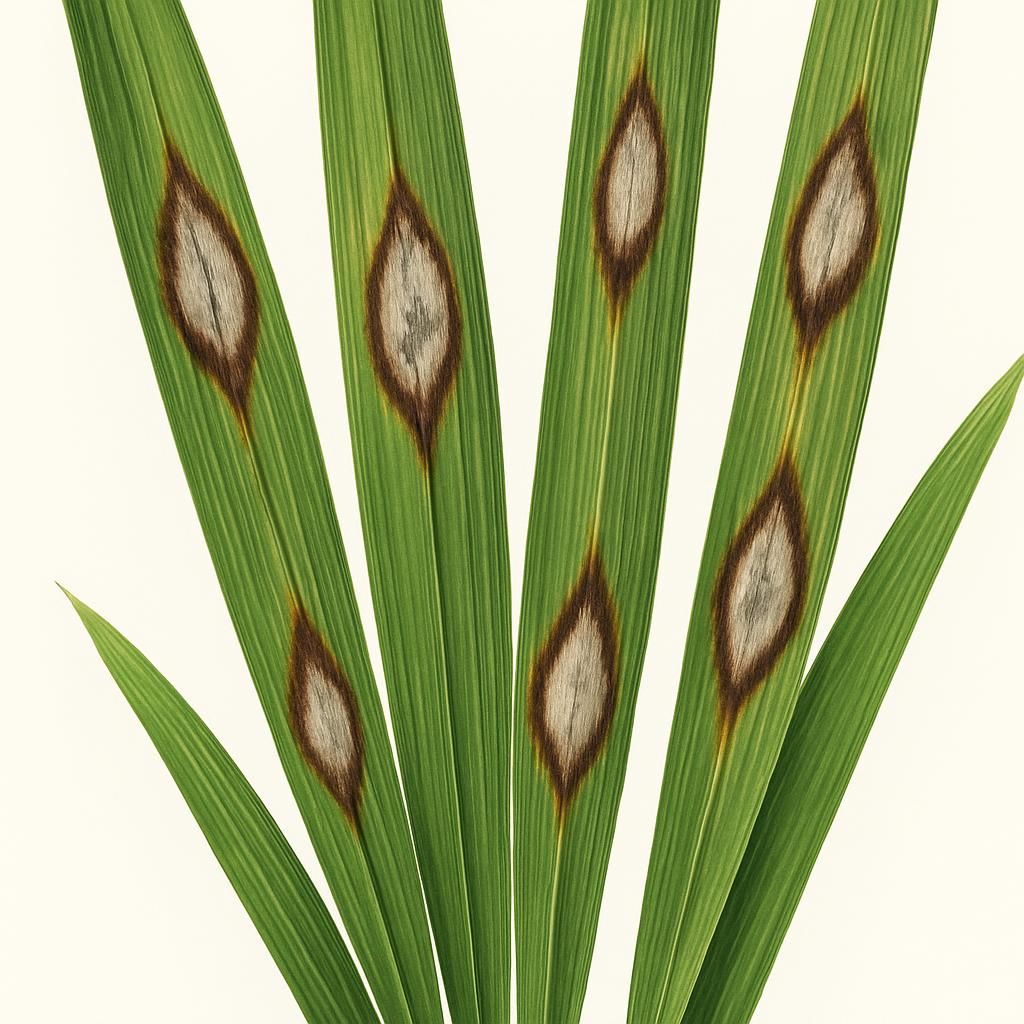
Introduction to Magnaporthe oryzae
Magnaporthe oryzae (syn. Pyricularia oryzae) is an ascomycete fungus responsible for rice blast disease, causing annual global yield losses estimated at 10–30%. The pathogen infects all above-ground parts of the rice plant and thrives in warm, humid environments typical of rice-growing regions. Its ability to overcome host resistance rapidly makes it a constant threat to food security, particularly in Asia and Africa where rice is a staple crop.
Identifying Symptoms & Damage
Early leaf blast appears as small water-soaked spots that enlarge into diamond-shaped lesions with gray centers and dark brown margins. Severe infections cause leaf wilting and premature senescence. Neck blast manifests as dark lesions at the base of the panicle, leading to white, empty grains known as “blasted” heads. Collar rot at the node level can girdle stems and cause lodging. Grain infection reduces milling quality and seed viability.
Lifecycle and Progression of Magnaporthe oryzae
| Stage | Description | Duration | Key Conditions |
|---|---|---|---|
| Spore Production | Conidia form on lesions during periods of high humidity | 3–5 days | 25–28 °C, >90% RH |
| Spore Dispersal | Wind and rain splash carry conidia to new hosts | Hours | Wind >2 m/s, rain |
| Infection | Germ tubes form appressoria that penetrate leaf cuticle | 6–12 hours | Free water on leaf |
| Incubation | Latent period inside host tissue | 4–7 days | 20–30 °C |
| Symptom Expression | Visible lesions and sporulation begin | 7–14 days total | Continued moisture |
| Overwintering | Mycelium survives in crop residue and seed | Months | Cool, dry storage |
Environmental Triggers & Risk Factors
| Factor | Optimal Range for Disease | Management Implication |
|---|---|---|
| Temperature | 20–30 °C daytime | Avoid planting in peak heat windows |
| Relative Humidity | >85% for >10 hours | Improve canopy aeration |
| Leaf Wetness | >6 consecutive hours | Time irrigation to allow drying |
| Nitrogen Level | High (>120 kg N/ha) | Split applications; use slow-release forms |
| Planting Density | >25 plants/m² | Maintain recommended spacing |
| Soil pH | 5.5–6.5 | Liming if below 5.0 |
Organic Control & Treatment Plans
| Treatment Option | Application Frequency | Rate/Details | Notes |
|---|---|---|---|
| Resistant Varieties | Once per season | Choose blast-resistant lines | Primary defense |
| Crop Rotation | Annual | Rotate with non-hosts for 1–2 years | Reduces inoculum |
| Field Sanitation | Pre-plant & post-harvest | Remove/burn residue | Lowers overwintering spores |
| Potassium Silicate Foliar Spray | Every 14 days from tillering | 2–4 L/ha | Strengthens cell walls |
| Neem Oil (azadirachtin) | Every 7–10 days during high risk | 0.5% emulsion | Suppresses sporulation |
| Bacillus subtilis Bio-fungicide | Every 10–14 days | 1–2 kg/ha | Colonizes phyllosphere |
| Compost Tea | Weekly during vegetative stage | 5% dilution | Boosts microbial antagonism |
Preventing Magnaporthe oryzae in the Future
Select certified seed of blast-resistant cultivars and avoid continuous rice monoculture. Implement balanced nutrition with adequate potassium and silicon. Maintain field drainage to minimize leaf wetness duration. Scout weekly during tillering and booting stages. Remove volunteer rice and weeds that serve as alternate hosts. Deep-plow or burn crop residues after harvest to destroy overwintering inoculum. Consider The Overlooked Art of Crop Rotation for Small Farm Resilience for long-term soil and disease management strategies.
Crops Most Affected by Magnaporthe oryzae
While Rice is the primary host, Magnaporthe oryzae can also infect Wheat, Barley, and several grass species. Cross-infection risk increases when rice and wheat are grown in rotation or adjacent fields. Monitoring nearby grassy weeds and volunteer cereals is essential to prevent spillover infections.