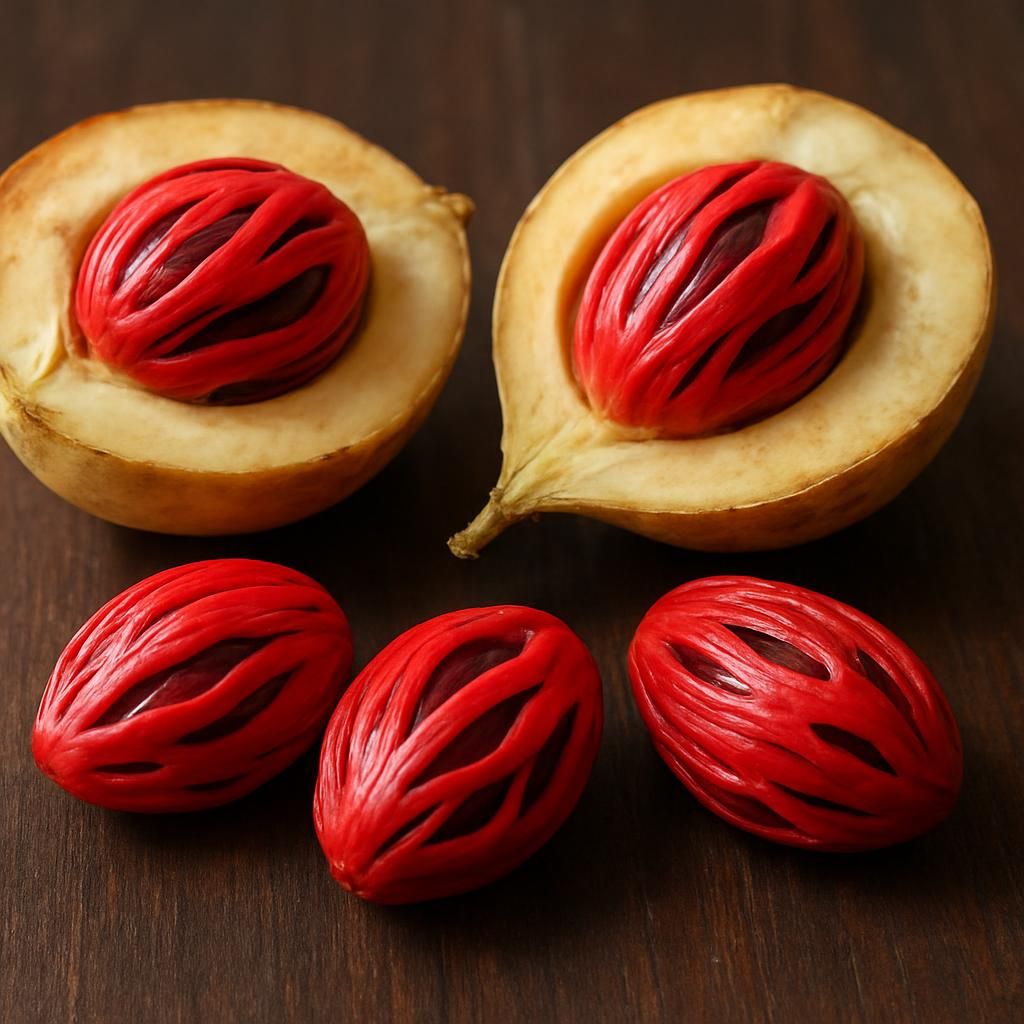
Introduction to Mace
Mace (Myristica fragrans) is the dried, reddish-orange aril that envelops the nutmeg seed. Harvested from the same evergreen tree that produces nutmeg, mace offers a warm, slightly sweeter flavor profile valued by chefs and spice traders worldwide. Commercial cultivation is concentrated in tropical regions with deep, fertile soils and consistent rainfall, where trees can remain productive for 40–60 years once established.
Because mace commands a premium price compared with nutmeg, growers who manage orchards correctly enjoy strong economic returns. Success depends on selecting suitable land, maintaining soil health, and implementing integrated pest management focused on the few insects and fungi that specifically target Myristica fragrans. This guide covers every production stage from propagation through curing and storage.
Botanical Profile of Mace
Myristica fragrans belongs to the Myristicaceae family and is a dioecious evergreen tree reaching 10–20 m at maturity. The alternate, elliptical leaves are dark green above and pale beneath, releasing a spicy aroma when crushed. Small, pale-yellow, unisexual flowers appear year-round in axillary clusters. Female trees produce pendulous, pear-shaped fruits 7–10 cm long that split open at maturity to reveal the bright red aril (mace) tightly wrapped around the dark brown seed (nutmeg).
The aril dries to a brittle, horn-like texture and is separated by hand or mechanically before further processing. Genetic variability exists between high-mace and high-nutmeg cultivars; commercial orchards typically plant 10–12 % male trees for pollination. Trees begin bearing at 6–8 years and reach full production between 15–25 years.
Soil, pH, and Climate Requirements for Mace
Myristica fragrans thrives in deep, well-drained loamy soils rich in organic matter. Waterlogging quickly leads to Phytophthora root rot, so raised beds or gentle slopes are essential on heavier soils. The species tolerates a narrow pH window and requires steady warmth without prolonged dry seasons.
| Parameter | Ideal Range | Notes |
|---|---|---|
| Soil Type | Deep sandy loam to clay loam | Minimum 1.5 m rooting depth |
| Soil pH | 5.5–6.8 | Avoid alkaline conditions |
| Organic Matter | 3–5 % | Incorporate compost or well-rotted manure |
| Annual Rainfall | 2000–3500 mm | Evenly distributed; supplement in dry spells |
| Temperature Range | 20–30 °C (day); 15 °C minimum | Frost causes leaf scorch and dieback |
| Altitude | 0–600 m a.s.l. | Lower yields above 800 m |
| Relative Humidity | 70–90 % | Supports flowering and fruit set |
Step-by-Step Planting & Propagation
- Seed Selection & Pre-treatment: Collect fresh, fully ripe nutmeg seeds from high-yielding female trees. Soak cleaned seeds in water for 24 hours, then sow immediately because viability declines rapidly.
- Nursery Phase: Use 25 cm × 15 cm polybags filled with a sterilized 2:1:1 mix of topsoil, sand, and compost. Sow seeds 3 cm deep; germination occurs in 30–45 days at 25–28 °C.
- Shade Management: Maintain 50 % shade for the first 6 months, then gradually harden seedlings under 25 % shade until field planting at 12–18 months when plants reach 60–80 cm.
- Field Layout: Plant at 6 m × 6 m spacing (278 trees/ha) with one male tree per nine females. Dig 60 cm × 60 cm × 60 cm pits; backfill with topsoil mixed with 10 kg compost and 100 g rock phosphate.
- Planting Time: Begin at the onset of the rainy season. Water transplants daily for the first two weeks, then weekly until established.
Care & Maintenance regimes for Mace
Young trees require consistent moisture and balanced nutrition to develop strong frameworks. Once canopy closure occurs at year 4–5, irrigation and fertilizer schedules shift to maintenance levels. Pruning focuses on removing dead wood and opening the canopy for light penetration and spray coverage.
| Operation | Frequency & Rate | Timing |
|---|---|---|
| Irrigation | 20–30 L/tree/week in dry season; drip or micro-sprinkler preferred | Year-round except peak monsoon |
| Fertilizer (N-P-K) | Year 1: 100 g 15-15-15/tree; increase to 1.5 kg/tree by year 8; split 3×/year | March, July, November |
| Organic Manure | 10–20 kg well-rotted FYM or compost per tree annually | Pre-monsoon (May) |
| Micronutrients | Foliar ZnSO₄ 0.5 % + Borax 0.2 % twice yearly | Flowering flush & fruit set |
| Pruning | Remove dead/diseased branches; thin interior canopy 20–25 % | After main harvest (Feb–Mar) |
| Mulching | 10 cm layer of dried leaves or coconut husk within 1 m radius | Year-round, renew twice yearly |
Pests, Diseases & Organic Management
The principal threats are nutmeg weevil, scale insects, and Phytophthora species causing collar and root rot. Implement sanitation, resistant rootstocks where available, and approved organic sprays.
- Scale insects: Scout underside of leaves; release Cryptolaemus montrouzieri and apply neem oil (3 %) at first sign.
- Nutmeg weevil: Collect and destroy fallen fruits; apply entomopathogenic nematodes around the base in early monsoon.
- Phytophthora collar rot: Improve drainage, avoid over-irrigation, and drench with Trichoderma viride (2 g/L) at planting and every six months.
- Leaf spot (Cercospora): Remove affected leaves and apply copper hydroxide (0.3 %) during prolonged wet periods.
Regular monitoring combined with cultural practices keeps pesticide use minimal while protecting yields.
Harvesting, Curing & Optimal Storage
Fruits are harvested when the husk begins to split naturally, usually 6–9 months after flowering. Pick by hand or with long-pole cutters to avoid bruising. Separate the red aril (mace) from the seed within 24 hours.
Mace is flattened by hand or machine and sun-dried on clean trays for 4–6 days until moisture drops below 10 %. Store in airtight, food-grade containers away from direct light. Properly cured mace retains color and volatile oils for 18–24 months. For export, vacuum-seal in moisture-barrier bags and label with harvest date and lot number.
Companion Planting for Mace
Mace benefits from carefully chosen companions that improve soil biology, provide light shade during establishment, and deter pests. Interplant rows with legumes such as pigeon pea or gliricidia for nitrogen fixation and wind protection. Low-growing marigold or rosemary under the canopy suppresses nematodes and repels aphids. Avoid shallow-rooted vegetables that compete for surface moisture. Maintain a 2 m weed-free strip around each trunk to reduce rodent habitat and facilitate harvest operations.