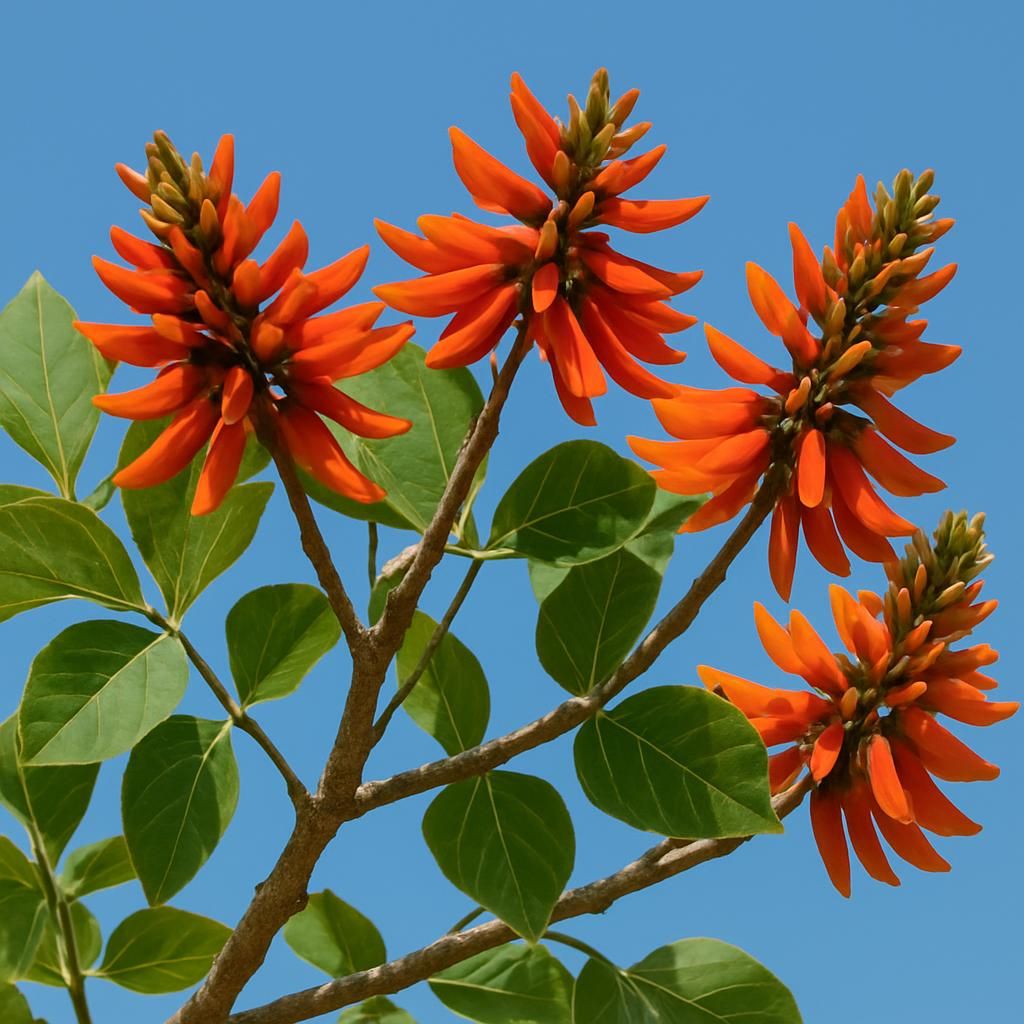
Introduction to Erythrina poeppigiana
Erythrina poeppigiana is a medium to large deciduous tree native to the tropical regions of South America. It is widely cultivated throughout the humid tropics for its exceptional nitrogen-fixing ability, rapid growth rate, and striking seasonal display of bright orange-red flowers. Farmers and agronomists value this species as a living fence, shade tree for coffee and cacao plantations, and a source of high-protein fodder for livestock. The tree reaches 15–25 meters in height with a spreading crown and thorny trunk, making it both functional and ornamental in agricultural landscapes.
Because of its deep root system and symbiotic relationship with Rhizobium bacteria, Erythrina poeppigiana improves soil fertility while providing microclimate benefits to understory crops. Its lightweight wood is occasionally used for light construction, while the flowers attract pollinators and the fallen leaves contribute organic matter to the soil. The species has become naturalized in parts of Central America, the Caribbean, and Southeast Asia, where it plays an important role in sustainable farming systems.
Botanical Profile of Erythrina poeppigiana
Erythrina poeppigiana belongs to the Fabaceae family and is characterized by its trifoliate leaves, bright red-orange papilionaceous flowers, and flattened, dehiscent pods containing bright red seeds. The bark is grayish-brown and covered with conical spines when young, becoming smoother with age. Flowers appear in terminal racemes before or during leaf flush, creating a spectacular visual effect that has earned the tree its common name “mountain immortelle.”
The species is closely related to other Erythrina species such as Gliricidia and Pigeon pea, sharing similar nitrogen-fixing capabilities and utility in agroforestry. Seeds are toxic if ingested raw due to the presence of alkaloids, but the foliage is highly palatable to ruminants when properly managed. The tree exhibits a fast growth rate, often reaching 3–4 meters in the first year under optimal conditions.
Soil, pH, and Climate Requirements for Erythrina poeppigiana (MUST INCLUDE A MARKDOWN TABLE OF IDEAL CONDITIONS)
Erythrina poeppigiana thrives in well-drained, fertile soils with moderate to high organic matter content. It tolerates a wide range of soil textures from sandy loam to clay loam but performs best in deep, aerated profiles. The species prefers slightly acidic to neutral pH and is sensitive to waterlogging, which can lead to root rot. It is adapted to tropical and subtropical climates with distinct wet and dry seasons.
| Parameter | Ideal Range | Notes |
|---|---|---|
| Soil Type | Sandy loam to clay loam | Well-drained, fertile soils preferred |
| Soil pH | 5.5 – 7.0 | Slightly acidic to neutral |
| Temperature | 20–32 °C | Frost sensitive below 10 °C |
| Annual Rainfall | 1200–2500 mm | Evenly distributed or with dry season |
| Altitude | 0–1500 m | Performs well in lowland and mid-elevation |
| Sunlight | Full sun to partial shade | Requires at least 6 hours direct sun |
Step-by-Step Planting & Propagation
Propagation of Erythrina poeppigiana is most successful from semi-hardwood cuttings taken during the dry season. Select healthy branches 2–3 cm in diameter and 40–60 cm long. Remove leaves and plant cuttings at a 45-degree angle in well-drained media, keeping the soil moist but not waterlogged. Rooting usually occurs within 4–6 weeks.
Direct seeding is possible but less reliable due to hard seed coats. Scarify seeds by soaking in hot water for 24 hours or nicking the coat before sowing in nursery beds. Transplant seedlings when they reach 30–50 cm in height, spacing trees 4–6 meters apart in rows or 8–10 meters in agroforestry systems. Plant at the onset of the rainy season to ensure establishment.
Care & Maintenance regimes for Erythrina poeppigiana (MUST INCLUDE A MARKDOWN TABLE OF WATER, FERTILIZER, AND PRUNING SCHEDULES)
Young trees require regular irrigation during the first two dry seasons. Once established, the deep taproot allows the tree to access groundwater, reducing supplemental water needs. Fertilization is generally minimal because of the tree’s nitrogen-fixing ability, but phosphorus and potassium applications can boost early growth. Pruning is essential to maintain a manageable canopy and encourage lateral branching for shade or fodder production.
| Activity | Frequency | Details |
|---|---|---|
| Watering | Weekly for first 6 months | 20–30 L per tree; reduce after establishment |
| Fertilizer | At planting & year 1 | 100 g NPK 10-20-10 + 50 g rock phosphate |
| Pruning | Twice yearly | Remove 30–40% canopy at end of dry season |
| Mulching | Annually | 5–10 cm organic mulch around base |
| Weeding | Monthly for first year | Maintain 1 m weed-free circle |
Pests, Diseases & Organic Management
Common pests include aphids, scale insects, and stem borers that can weaken young trees. Fungal issues such as Phytophthora root rot may occur in poorly drained soils. Regular monitoring, removal of infested branches, and applications of neem oil or insecticidal soap provide effective organic control. Maintaining good airflow through pruning reduces disease pressure.
Harvesting, Curing & Optimal Storage
Erythrina poeppigiana is primarily harvested for its foliage and flowers rather than fruit. Fodder is collected by pollarding branches at 1.5–2 meters height every 4–6 months. Leaves should be wilted for 24 hours before feeding to livestock to reduce alkaloid content. Seeds are rarely harvested but can be collected when pods turn brown and stored in cool, dry conditions for up to two years.
Companion Planting for Erythrina poeppigiana
The tree excels as a companion in coffee, cacao, and banana systems where it provides shade and nitrogen. It pairs well with Coffee, Cacao, and Banana understories. Leguminous ground covers such as Clover and Hairy vetch further enhance soil fertility. Avoid planting near shallow-rooted vegetables that may compete for moisture during establishment.