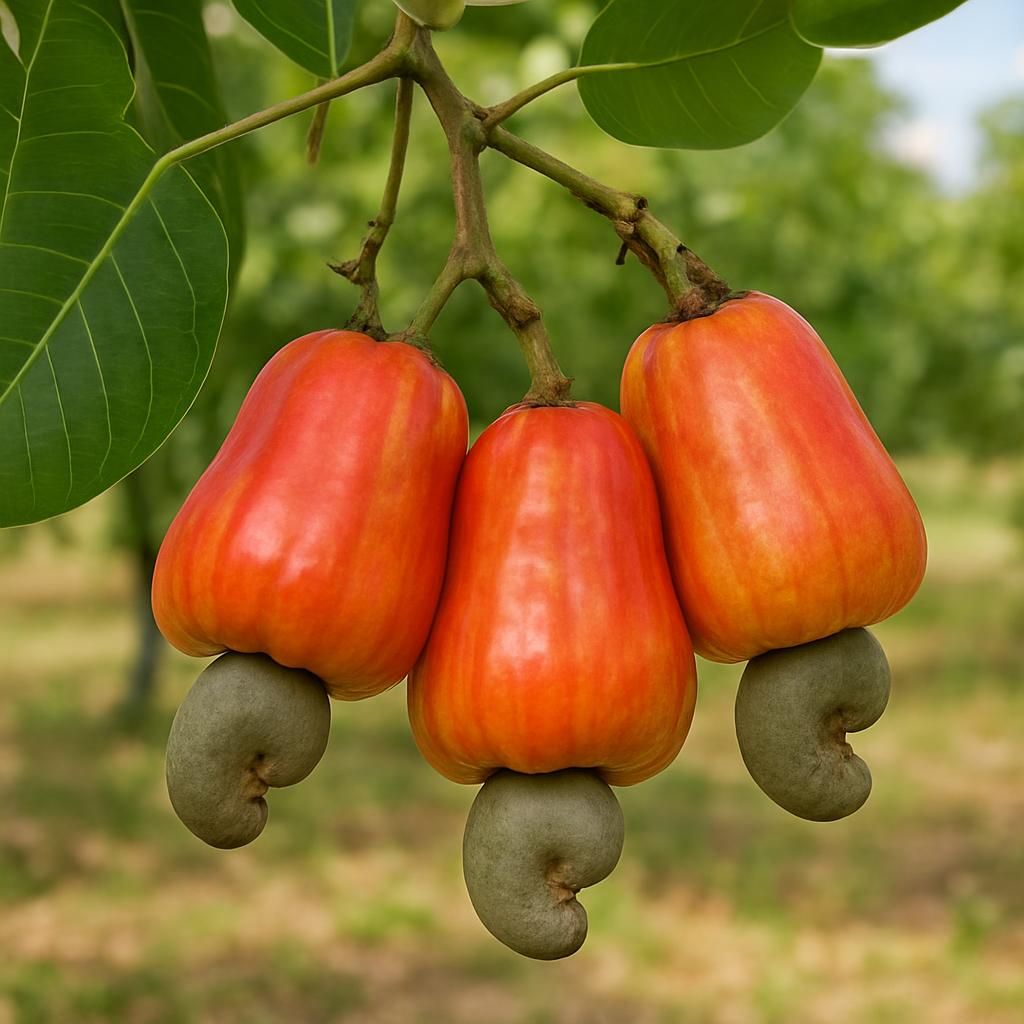
Introduction to Cashew (Anacardium occidentale)
Cashew (Anacardium occidentale) is a fast-growing evergreen tree native to northeastern Brazil that has become one of the world’s most important tree-nut crops. The tree produces the familiar cashew nut and the fleshy cashew apple, both of which have significant economic and nutritional value. Today, India, Vietnam, Côte d’Ivoire, and Brazil dominate global production, while smallholder orchards in East Africa continue to expand. Professional cultivation emphasizes early grafting, proper spacing, and integrated management of pests such as Tea Mosquito Bug to ensure sustainable profitability.
Botanical Profile of Cashew (Anacardium occidentale)
The cashew tree belongs to the Anacardiaceae family and can reach 10–12 m in height with a spreading canopy. Its leathery, obovate leaves are alternately arranged and release a milky latex when damaged. Small, fragrant, yellowish-pink flowers appear in terminal panicles; only a small percentage set fruit. The true fruit is a kidney-shaped drupe containing the single seed (cashew nut) that develops outside the fleshy, pear-shaped cashew apple. The nut is enclosed in a double shell containing the caustic phenolic resin known as cashew nut shell liquid (CNSL).
Soil, pH, and Climate Requirements for Cashew (Anacardium occidentale)
Cashew performs best on deep, well-drained sandy loam or lateritic soils with good aeration. The species tolerates poor, infertile soils but responds strongly to organic amendments. Waterlogging is fatal even for short periods. Ideal conditions are summarized below:
| Parameter | Ideal Range | Notes |
|---|---|---|
| Soil Type | Sandy loam to laterite | Avoid heavy clay and waterlogged sites |
| Soil pH | 5.5–7.5 | Slightly acidic to neutral preferred |
| Temperature | 20–32 °C | Frost sensitive below 10 °C |
| Annual Rainfall | 800–2,000 mm | Dry spell during flowering beneficial |
| Altitude | 0–800 m | Lowland tropics optimal |
| Relative Humidity | 60–80 % | High humidity favors fungal diseases |
Step-by-Step Planting & Propagation
- Select healthy, high-yielding mother trees and collect semi-hardwood scions 6–8 mm in diameter.
- Raise rootstocks from fresh, large seeds sown 5 cm deep in polybags; germination occurs in 7–15 days.
- Perform soft-wood or cleft grafting when seedlings are 25–30 cm tall (3–4 months old).
- Harden grafts under 50 % shade for 4–6 weeks before field planting.
- Prepare planting pits 60 × 60 × 60 cm; refill with topsoil mixed with 10 kg well-rotted manure and 100 g rock phosphate.
- Transplant at 7 m × 7 m spacing (200 trees/ha) during the early monsoon; water immediately.
- Provide temporary shade and windbreaks for the first two seasons.
Care & Maintenance regimes for Cashew (Anacardium occidentale)
Regular canopy management, balanced nutrition, and moisture conservation are essential for sustained productivity. The following schedules guide professional practice:
| Operation | Frequency / Timing | Details |
|---|---|---|
| Irrigation | 4–6 times/year in dry season | 40–60 L per tree per irrigation; drip preferred |
| Fertilizer (Year 1–3) | 3 split applications | 250 g N, 125 g P₂O₅, 125 g K₂O + 10 kg FYM per tree |
| Fertilizer (Mature) | 2 split applications (pre- & post-monsoon) | 500 g N, 250 g P₂O₅, 250 g K₂O + 25 kg FYM per tree |
| Pruning | Annual light prune after harvest | Remove dead, diseased, and crossing branches; maintain 3–4 m height |
| Mulching | At onset of dry season | 10–15 cm organic mulch within 1 m radius |
Pests, Diseases & Organic Management
Major insect pests include the tea mosquito bug, stem and root borers, and mealybugs. Fungal threats encompass anthracnose, powdery mildew, and pink disease. Implement weekly scouting, destroy alternate hosts, and apply neem-based sprays (0.5 %) at flowering. For anthracnose, copper hydroxide (0.3 %) combined with cultural sanitation is effective. Encourage predatory ants and birds; install light traps during peak moth activity. Maintain orchard hygiene by removing fallen nuts and pruning debris.
Harvesting, Curing & Optimal Storage
Mature nuts fall naturally 70–80 days after flowering. Collect daily to avoid mold and CNSL staining. Sun-dry nuts on clean mats to 8–10 % moisture over 3–4 days; turn frequently. Store in jute bags or silos at <65 % RH and 10–15 °C. For cashew apples, process within 24 hours into juice or dried slices. Properly cured nuts retain quality for 12–18 months.
Companion Planting for Cashew (Anacardium occidentale)
Interplant young orchards with pigeon pea or gliricidia to fix nitrogen and provide temporary shade. Leguminous cover crops such as cowpea suppress weeds and improve soil structure. Aromatic herbs like thyme and rosemary repel sucking insects. Avoid planting solanaceous crops nearby to limit shared pests. Mature cashew canopies support understory cultivation of shade-tolerant species such as turmeric or pineapple during the first five years.