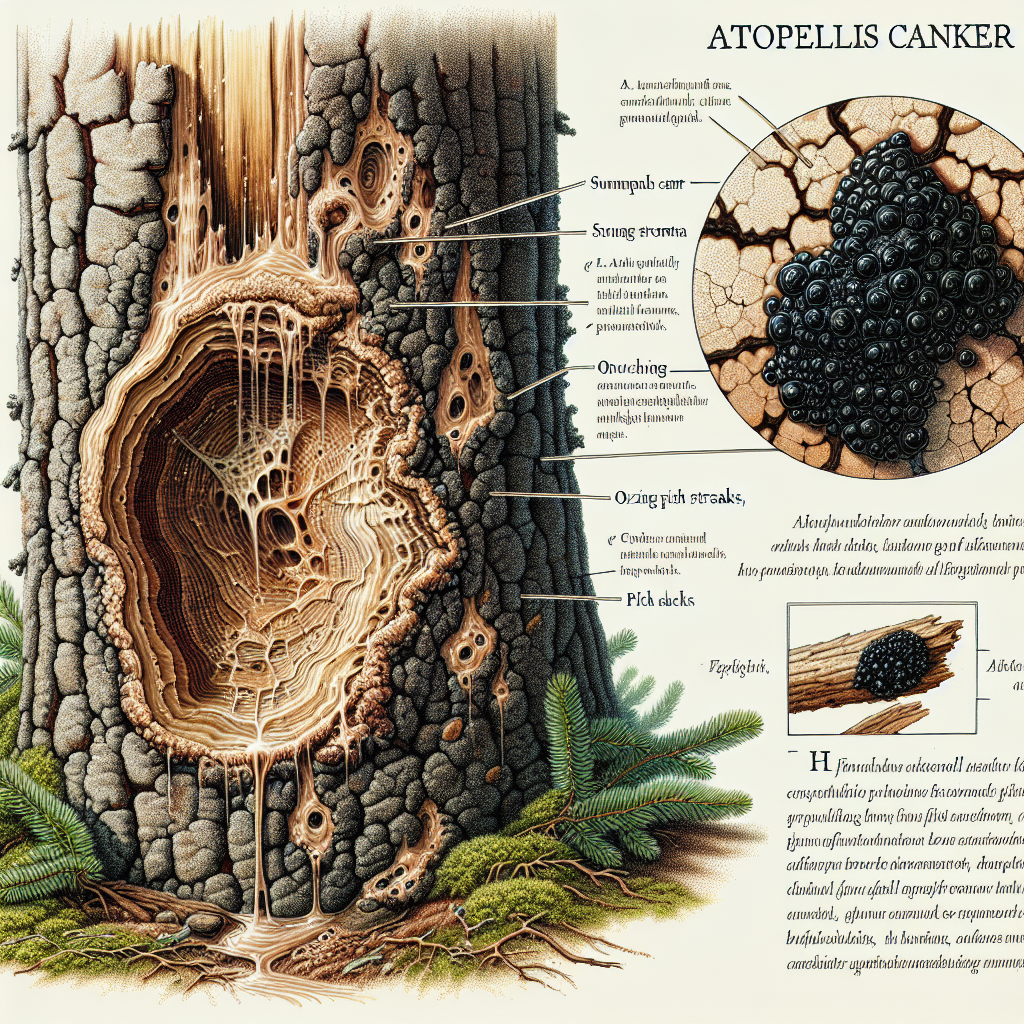
Introduction to Atropellis canker
Atropellis canker, caused by the fungal pathogen Atropellis pinastri (formerly known as Naeviopsis pinastri), represents a significant threat to coniferous trees, particularly species in the genus Abies (true firs). This disease manifests as sunken, resin-soaked cankers on stems and branches, often leading to girdling, dieback, and eventual tree death. First identified in Europe in the early 20th century, it has spread to North America, impacting forestry operations and Christmas tree farms. The pathogen thrives in cool, moist environments, entering through wounds or branch stubs, and produces black, flask-shaped fruiting bodies that release spores during wet periods.
Understanding Atropellis canker is crucial for timber producers, nursery operators, and small-scale growers cultivating firs for ornamental or holiday purposes. Unlike many foliar diseases, this canker targets woody tissues, making it insidious and difficult to eradicate once established. Annual economic losses in affected regions can exceed millions due to reduced timber quality and plantation thinning. This definitive guide equips agricultural professionals with diagnostic tools, lifecycle insights, and proven organic management plans to combat this pest effectively. By integrating cultural practices, biological controls, and vigilant monitoring, growers can protect yields and sustain long-term forest health. For related fungal issues, see Phytophthora.
Identifying Symptoms & Damage
Accurate diagnosis begins with recognizing the distinctive symptoms of Atropellis canker. Initial signs appear as small, sunken lesions on branches or trunks, often near pruning wounds or mechanical injuries. These lesions expand into elliptical cankers, typically 2-12 inches long, with dark, resin-soaked bark that cracks and peels away, exposing reddish-brown to blackish wood beneath. A hallmark feature is the copious resin flow, forming vertical streaks or 'pitch tubes' that harden over time.
Affected bark often exhibits a grayish-white mycelial fan beneath the surface, and in advanced stages, black stromata (fruiting bodies) stud the canker surface like pepper grains. Needles above the canker yellow, wilt, and drop, leading to crown thinning. Severe girdling cankers cause branch dieback or whole-tree mortality, with trees declining over 1-3 years. Differentiate from similar diseases like cytospora canker (which produces orange spore masses) or lightning strikes (lacking resin and stromata).
Damage assessment involves measuring canker dimensions and noting tree vigor. Young trees (under 10 years) suffer highest mortality rates, up to 50% in dense stands. Economic impacts include reduced log value from defects and increased susceptibility to secondary pests like bark beetles. Scout plantations weekly during spring and fall, using a hand lens to confirm stromata. Early detection via these symptoms allows timely intervention, preventing spread. For complementary diagnostics, explore Spring Pest Patrol: Organic AI Strategies to Shield Your Crops from Common Invaders.
Lifecycle and Progression of Atropellis canker
The lifecycle of Atropellis pinastri is tightly linked to moisture and temperature, spanning multiple years. Primary infection occurs via ascospores released from black stromata on cankers during wet weather (April-June in temperate zones). These wind-dispersed spores germinate on wounded bark, penetrating directly or through lenticels. Mycelium colonizes cambium and phloem, forming a canker within months.
Stromata mature after 1-2 years, producing perithecia (flask-like structures) that eject ascospores in spring rains. Asexual conidia may also form in moist conditions, splashing short distances. The pathogen overwinters as mycelium in bark. Disease progression accelerates in cool (45-65°F), humid environments, with cankers expanding 1-2 inches annually. Latent infections can remain asymptomatic for years, activating under stress.
Full cycle: spore germination (24-48 hours post-rain), mycelial growth (weeks), canker formation (months), stroma development (1-2 years), sporulation (spring). High inoculum loads from nearby infected trees amplify epidemics. Understanding this progression informs timing for controls, such as pruning during dry periods to minimize spore spread.
Environmental Triggers & Risk Factors
Atropellis canker epidemics are driven by specific environmental cues and management practices. Cool, wet springs and falls (over 30 inches annual rainfall) promote ascospore dispersal and infection, with optimal temperatures of 50-60°F. Dense plantings (>500 trees/acre) create humid microclimates, increasing risk by 300%. Poor air circulation from overcrowding or heavy pruning exacerbates spread.
Mechanical wounds from logging, pruning, or animal damage serve as entry points; avoid operations in wet seasons. Susceptible species include noble fir (Abies procera), grand fir (Abies grandis), and subalpine fir (Abies lasiocarpa). Stressed trees—due to drought, nutrient deficiency, or prior defoliation—are 5x more vulnerable. Acidic soils (pH <5.5) and high nitrogen fertilization indirectly favor the pathogen by promoting succulent growth.
Risk mapping involves assessing site history: proximity to infected stands (<1 mile) raises odds dramatically. Climate change may intensify outbreaks via erratic wet periods. Mitigate by selecting resistant rootstocks and monitoring weather forecasts.
Organic Control & Treatment Plans
Organic management emphasizes cultural, biological, and physical tactics, avoiding synthetic fungicides. Pruning: Remove cankers with 6-8 inches healthy margin using sterilized tools; destroy prunings (burn or solarize). Prune in dry weather (>3 dry days forecast). Sanitation: Rake and compost fallen branches; mulch to suppress splash dispersal.
Biologicals: Apply Trichoderma spp. or Bacillus subtilis biopesticides to wounds post-pruning; these antagonize mycelium. Compost teas with actinomycetes enhance tree resistance. Nutritional boosts: Foliar calcium and potassium sprays strengthen bark; avoid excess nitrogen.
Integrated plan: 1) Scout biweekly; 2) Prune infected parts; 3) Apply biofungicides; 4) Thin stands to 300 trees/acre; 5) Irrigate deeply but infrequently to reduce stress. Efficacy reaches 70-85% with early action. Monitor via sticky traps for spore loads. Combine with resistant varieties for best results.
Preventing Atropellis canker in the Future
Prevention hinges on proactive strategies. Plant certified disease-free stock from reputable nurseries. Space trees 8-12 feet apart for airflow. Use wound dressings (organic latex-based) on all cuts. Rotate species; interplant with non-hosts like Douglas-fir if available. Soil test annually, amending to pH 6.0-7.0.
Establish buffer zones around plantations. Employ cover crops to improve drainage. Annual inspections with trained scouts prevent outbreaks. Resistance breeding programs offer promising cultivars. Long-term, diversify plantings to buffer losses. These steps can reduce incidence by 90%.
Crops Most Affected by Atropellis canker
Primary hosts are true firs: noble fir (Abies procera), grand fir (Abies grandis), Nordmann fir (Abies nordmanniana), and Fraser fir (Abies fraseri). Noble fir suffers most in Pacific Northwest plantations, with losses up to 40%. Subalpine fir (Abies lasiocarpa) is highly susceptible in high-elevation sites. Minor hosts include some spruces (Picea spp.) and pines (Pinus spp.), though rarely. Christmas tree farms bear heaviest economic brunt, followed by timber stands. Ornamental landscapes with fir hedges also at risk.