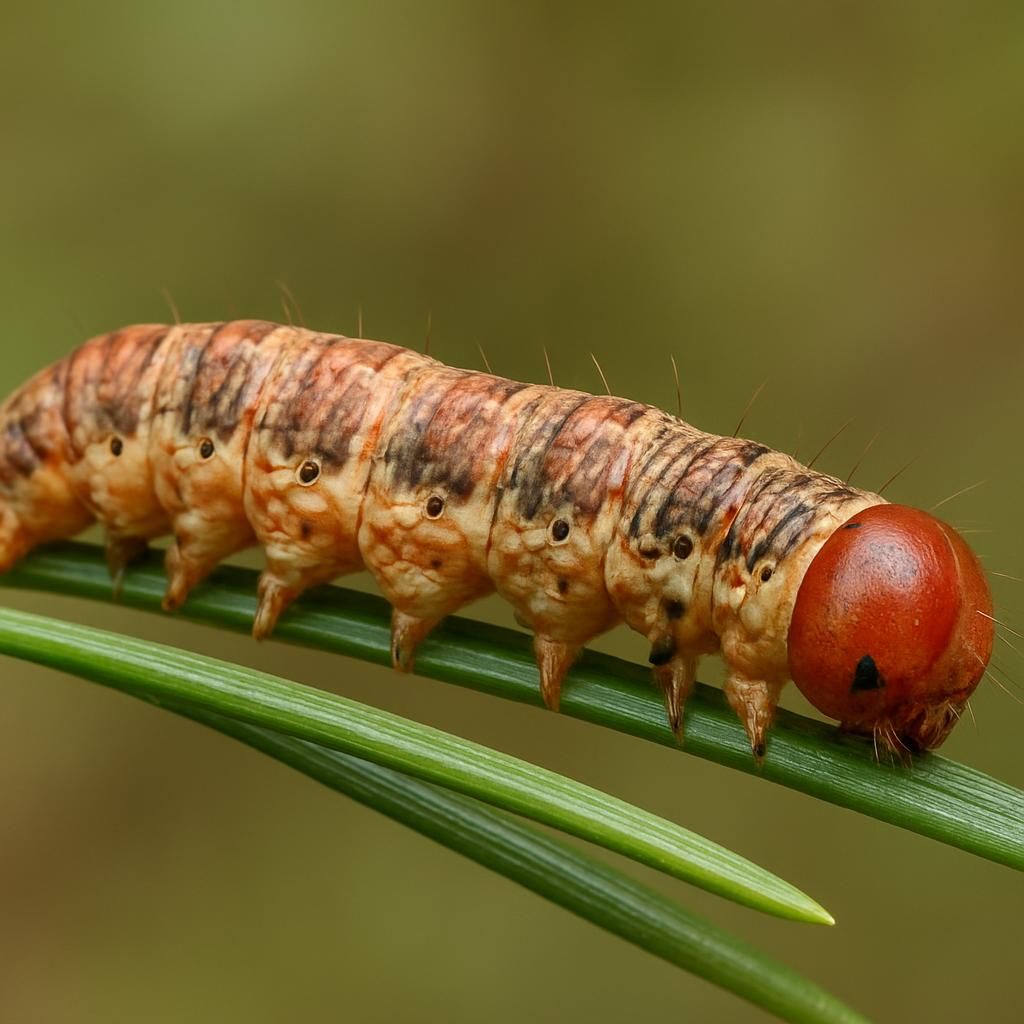
Introduction to spruce budworm
The spruce budworm (Choristoneura fumiferana) is a tortricid moth whose larvae feed primarily on the current-year foliage of spruce (Picea spp.) and balsam fir (Abies balsamea). Native to North America, it is the most economically important defoliator in the boreal and northern hardwood regions of the United States and Canada. Outbreaks occur every 30–40 years and can last 5–15 years, causing widespread tree mortality, reduced growth, and altered forest composition. The insect’s impact extends beyond forestry to recreation, wildlife habitat, and carbon sequestration.
Identifying Symptoms & Damage
Early signs appear in late spring when larvae mine into expanding buds, causing them to turn reddish-brown and fail to flush. As feeding progresses, larvae web needles together and consume entire shoots, producing a scorched appearance at the crown. Heavy infestations lead to top-kill, branch dieback, and reduced cone production. Frass pellets accumulate in branch crotches and on the forest floor. Secondary symptoms include increased susceptibility to armyworms and wood-boring beetles.
Lifecycle and Progression of spruce budworm (MUST INCLUDE A MARKDOWN TABLE OF LIFECYCLE STAGES)
The spruce budworm completes one generation per year. Overwintering occurs as second-instar larvae inside hibernacula on the bark. Spring emergence coincides with bud break of host trees.
| Stage | Timing | Description | Key Activity |
|---|---|---|---|
| Egg | July–August | 20–60 eggs laid in overlapping masses on needles | Embryonic development |
| Larva (L1–L2) | Late summer–fall | First and second instars mine needles then spin hibernacula | Overwintering preparation |
| Larva (L3–L6) | Spring–early summer | Active feeding on buds and foliage; most destructive stages | Defoliation and growth |
| Pupa | Late June–July | Formed inside silken cocoons on foliage or bark | Metamorphosis |
| Adult | July–August | Mottled gray-brown moths; females lay eggs | Dispersal and oviposition |
Environmental Triggers & Risk Factors
Outbreaks are favored by consecutive years of warm, dry summers that increase larval survival and synchrony with bud flush. Dense, mature stands of balsam fir or white spruce with closed canopies provide optimal microclimates. Prolonged drought stress weakens tree defenses, while mild winters reduce overwintering mortality. Climate change models predict more frequent and severe outbreaks in northern latitudes.
Organic Control & Treatment Plans (MUST INCLUDE A MARKDOWN TABLE OF TREATMENT OPTIONS AND FREQUENCIES)
Integrated organic management emphasizes monitoring, biological controls, and cultural practices. Bacillus thuringiensis var. kurstaki (Btk) remains the primary microbial insecticide.
| Treatment Option | Application Window | Frequency | Notes |
|---|---|---|---|
| Bacillus thuringiensis (Btk) | When 50% of larvae at L3–L4 | 1–2 applications, 7–10 days apart | Most effective before larvae reach L5; rainfast within 24 h |
| Spinosad (Entrust) | Early larval stages | 1–2 applications | OMRI-listed; avoid during bloom to protect pollinators |
| Horticultural oil | Dormant or pre-bud break | Once per season | Smothers overwintering larvae; limited efficacy on older instars |
| Trichogramma minutum releases | Egg stage (July) | Weekly releases for 3 weeks | Augments natural parasitism; timing critical |
| Manual removal of egg masses | Late summer | As needed | Feasible only on small ornamental trees |
Preventing spruce budworm in the Future
Long-term prevention relies on silvicultural diversification. Replace pure fir or spruce monocultures with mixed-species stands containing 30–40% non-host hardwoods. Thinning dense stands improves tree vigor and reduces favorable microclimates. Retain 10–15% legacy trees and snags to support natural enemies. Regular aerial or ground surveys using pheromone traps and branch sampling allow early detection. Maintain soil health through organic amendments to enhance tree resilience.
Crops Most Affected by spruce budworm
While primarily a forestry pest, spruce budworm occasionally impacts Christmas tree plantations and high-value landscape conifers. The most severely affected species include white spruce (Picea glauca), black spruce (Picea mariana), red spruce (Picea rubens), and balsam fir (Abies balsamea). Secondary hosts include Douglas-fir (Pseudotsuga menziesii) and subalpine fir (Abies lasiocarpa).
For additional context on related conifer health issues, see the Wikipedia page on Choristoneura fumiferana. Readers interested in broader forest resilience strategies may also consult the blog post The Truth About Weather Patterns and Small Farm Resilience.