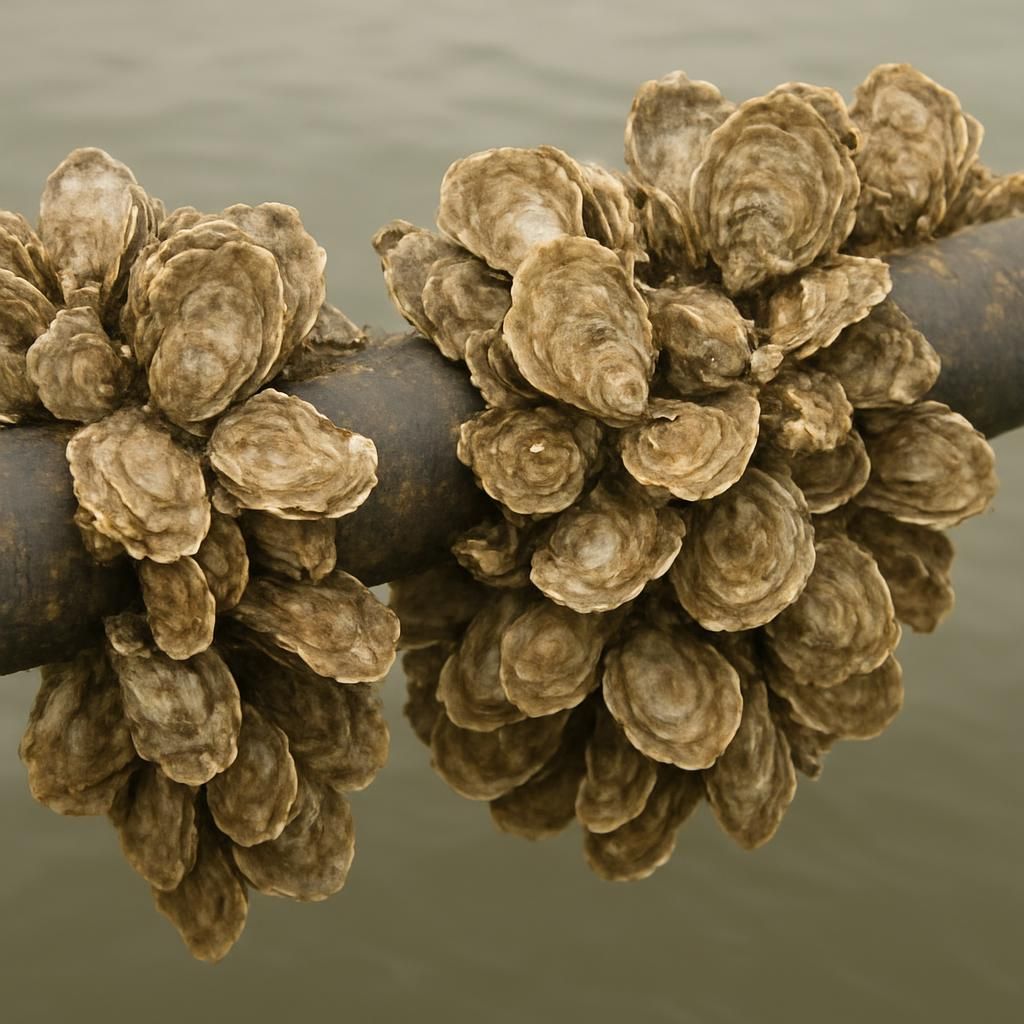
Introduction to Crassostrea virginica
Crassostrea virginica, the eastern oyster, is a euryhaline bivalve native to the western Atlantic but has established problematic populations in agricultural water systems along coastal regions. While valued in commercial shellfish aquaculture, its rapid colonization of irrigation canals, pumps, and hydroponic infrastructure creates serious operational challenges for farms near estuaries. Dense aggregations reduce water flow, clog intake screens, and accelerate corrosion of metal components. The pest thrives in salinities between 5–30 ppt and temperatures from 10–30 °C, allowing it to persist year-round in many subtropical and temperate growing areas.
Agricultural producers encounter Crassostrea virginica primarily through biofouling of water-delivery systems rather than direct crop feeding. The organism’s ability to filter large volumes of water while attaching permanently to hard substrates makes it especially disruptive in tidal-influenced farms. Early recognition and proactive management are essential because established colonies are extremely difficult to eradicate once shells have cemented to infrastructure.
Identifying Symptoms & Damage
The most visible sign of Crassostrea virginica infestation is the presence of rough, gray-white shells clustered on submerged pipes, pump housings, and canal walls. These shells range from 2–15 cm in length and exhibit concentric growth rings with a characteristic cupped lower valve. Heavy fouling reduces pipe diameter by up to 60 %, leading to decreased irrigation pressure and uneven water distribution across fields.
Secondary symptoms include increased energy consumption by pumps struggling against restricted flow and elevated maintenance costs from frequent screen cleaning. In extreme cases, complete blockage of intake structures can cause crop wilting or hydroponic nutrient imbalances. Unlike mobile pests, damage from Crassostrea virginica is cumulative and structural rather than acute foliar symptoms.
Lifecycle and Progression of Crassostrea virginica
Crassostrea virginica exhibits a complex lifecycle involving broadcast spawning, planktonic larvae, and sessile adults. Understanding each stage enables targeted intervention before permanent attachment occurs.
| Stage | Duration | Key Characteristics | Optimal Conditions |\n|--------------------|-------------------|----------------------------------------------|-------------------------------------| | Gamete Release | Hours | Broadcast spawning triggered by temperature rise | 20–28 °C, salinity 10–25 ppt | | Trochophore Larva | 12–24 hours | Free-swimming, ciliated, non-feeding | High plankton density | | Veliger Larva | 2–3 weeks | Develops shell, actively filters | 15–30 °C, abundant phytoplankton | | Pediveliger | 1–2 days | Develops foot for substrate exploration | Hard surfaces, moderate flow | | Settlement | Permanent | Cementation to substrate, metamorphosis | Salinity >5 ppt, low turbidity | | Juvenile Oyster | 3–12 months | Rapid shell growth, filter feeding | Nutrient-rich water | | Adult Oyster | 1–5+ years | Reproductive maturity, colony expansion | Stable salinity, tidal exchange |
Environmental Triggers & Risk Factors
Crassostrea virginica populations expand rapidly when water temperatures exceed 18 °C for consecutive weeks and salinity remains above 8 ppt. Farms located within 5 km of estuaries or with tidal canals face the highest risk. Nutrient enrichment from agricultural runoff promotes phytoplankton blooms that support larval survival. Stagnant or low-flow sections of irrigation infrastructure provide ideal settlement sites. Seasonal peaks typically occur from late spring through early autumn in temperate zones.
Organic Control & Treatment Plans
Integrated management combines mechanical removal, environmental manipulation, and biological agents. No single method provides complete control; rotation of tactics prevents resistance and reinfestation.
| Treatment Option | Method | Frequency | Notes |
|---|---|---|---|
| Manual Scraping | Physical removal with scrapers | Every 4–6 weeks | Best during low tide or system shutdown |
| High-Pressure Water Jet | 2000–3000 psi rinsing | Monthly during peak season | Effective on juveniles <2 cm |
| Salinity Manipulation | Flush with freshwater for 48 h | Quarterly | Kills larvae; requires containment |
| Copper-Based Barriers | 5 % copper paint on intakes | Annual reapplication | EPA-approved formulations only |
| Native Oyster Predator Stocking | Introduce blue crabs | Seasonal | Monitor predator density to avoid imbalance |
| UV Sterilization | Install inline UV units | Continuous operation | Targets planktonic larvae |
| Air-Drying of Equipment | Expose removed parts to sun 7+ days | As needed | Desiccates attached oysters |
Preventing Crassostrea virginica in the Future
Prevention focuses on excluding larvae and limiting settlement surfaces. Install 500-micron mesh screens on all intake points and inspect weekly. Schedule quarterly system flushes with low-salinity water during known spawning windows. Coat new infrastructure with non-toxic foul-release coatings before installation. Maintain records of water quality parameters to forecast larval pulses. Partner with neighboring farms for regional monitoring and coordinated flushing events.
Crops Most Affected by Crassostrea virginica
While Crassostrea virginica does not directly consume plant tissue, its presence severely impacts water-dependent production systems. Coastal rice paddies using estuarine water, tomato hydroponic facilities near bays, and strawberry farms with tidal irrigation are most vulnerable. Reduced water flow leads to nutrient deficiencies and increased disease pressure in these high-value crops. Early detection and infrastructure protection remain the most cost-effective strategies for protecting yields.