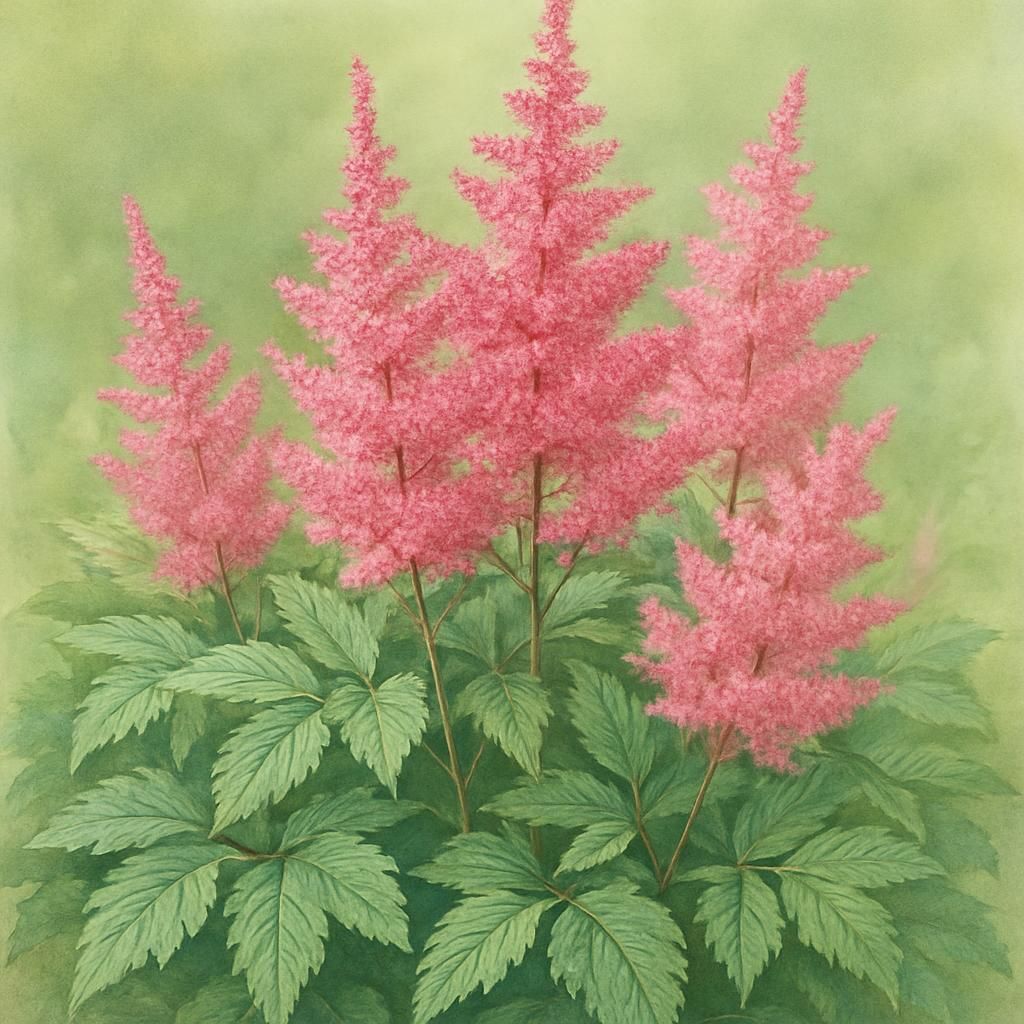
Introduction to Astilbe
Astilbe is a genus of approximately 18 species of clump-forming herbaceous perennials in the Saxifragaceae family. Native to mountain ravines and woodland edges across Asia and North America, these plants have become staples of temperate shade gardens worldwide. Their distinctive feathery flower spikes rise above deeply divided, fern-like leaves, delivering vibrant color from late spring through midsummer when many other shade plants have finished blooming.
Gardeners value Astilbe for its ability to brighten deeply shaded areas with plumes in shades of white, pink, red, lavender, and purple. The plants form dense mounds that suppress weeds and provide textural contrast when paired with hostas, ferns, and heucheras. Because they are largely deer-resistant and tolerant of wet soils, they are frequently planted near streams, ponds, and rain gardens. With proper site preparation and consistent moisture, Astilbe can remain productive for 10–15 years, making them an excellent long-term investment for both home landscapes and small-scale cut-flower production.
Botanical Profile of Astilbe
Astilbe species exhibit a clumping growth habit with short rhizomes that produce new crowns each spring. Mature plants typically reach 12–48 inches in height and spread 12–36 inches wide depending on cultivar. The compound leaves are usually 2–3 times ternately divided, giving a fine, lacy appearance. Flower panicles consist of hundreds of tiny florets arranged in dense, pyramidal or arching plumes. Bloom time ranges from May through August, with many cultivars offering 4–6 weeks of color. After flowering, the dried plumes persist into winter, providing structural interest and seed heads for birds.
Popular species include A. chinensis, A. japonica, A. simplicifolia, A. thunbergii, and the widely hybridized A. × arendsii group. Modern cultivars such as ‘Fanal’, ‘Rheinland’, and ‘Vision in Pink’ have been selected for improved flower density, foliage color, and heat tolerance.
Soil, pH, and Climate Requirements for Astilbe (MUST INCLUDE A MARKDOWN TABLE OF IDEAL CONDITIONS)
Astilbe performs best in fertile, moisture-retentive soils that never dry out completely during the growing season. Heavy clay soils are acceptable if amended with generous amounts of organic matter, while sandy soils require frequent irrigation or the addition of compost and leaf mold to improve water-holding capacity. The ideal pH range is slightly acidic to neutral.
| Parameter | Ideal Range | Notes |
|---|---|---|
| Soil Type | Loamy, organic-rich | Amend with compost or leaf mold |
| Soil pH | 5.5 – 7.0 | Slightly acidic to neutral |
| Soil Moisture | Consistently moist | Never allow to dry out completely |
| USDA Hardiness Zones | 3 – 8 | Mulch heavily in zones 3–4 |
| Temperature Range | 50–75 °F (10–24 °C) daytime | Protect from extreme heat and drying winds |
| Light Requirements | Partial to full shade | Tolerates morning sun if soil stays moist |
| Spacing | 12–24 inches (30–60 cm) | Wider spacing for larger cultivars |
Step-by-Step Planting & Propagation
Site Selection: Choose a location that receives dappled shade or morning sun with afternoon shade. Ensure the site has reliable moisture from rainfall, irrigation, or proximity to a water feature.
Soil Preparation: Dig the planting area to a depth of 12 inches. Incorporate 2–4 inches of well-rotted compost or leaf mold and mix thoroughly. Conduct a soil test and adjust pH if necessary with elemental sulfur (to lower) or lime (to raise).
Planting: Set bare-root divisions or container-grown plants so the crown sits at soil level. Space plants 12–24 inches apart. Water thoroughly after planting to settle the soil around the roots.
Mulching: Apply a 2-inch layer of shredded bark, pine needles, or leaf mold to conserve moisture and suppress weeds. Keep mulch 1 inch away from crowns to prevent rot.
Propagation: Divide established clumps every 3–4 years in early spring or immediately after flowering. Each division should contain at least 3–5 eyes. Replant divisions immediately or store briefly in moist sphagnum moss. Seed propagation is possible but slow; fresh seed sown in a cold frame will germinate in 4–8 weeks but may not bloom for 2–3 years.
Care & Maintenance regimes for Astilbe (MUST INCLUDE A MARKDOWN TABLE OF WATER, FERTILIZER, AND PRUNING SCHEDULES)
Astilbe is relatively low-maintenance once established, but consistent moisture and periodic division are essential for long-term vigor. Fertilization should be moderate; excessive nitrogen produces lush foliage at the expense of flowers. Deadheading spent plumes is optional but improves appearance. In late fall, leave dried foliage in place for winter protection and cut back in early spring.
| Season | Watering Schedule | Fertilizer Application | Pruning & Cleanup |
|---|---|---|---|
| Early Spring | 1 inch per week if no rain | Apply balanced slow-release (10-10-10) at 1 lb per 100 sq ft | Cut back old foliage to 2 inches |
| Late Spring | Maintain even moisture | Side-dress with compost tea | Remove any winter-damaged leaves |
| Summer | 1–1.5 inches weekly; more in heat | Light liquid seaweed or fish emulsion monthly | Deadhead spent plumes if desired |
| Autumn | Reduce frequency as plants go dormant | None needed | Leave dried foliage for winter interest |
| Winter | Ensure soil does not freeze-dry | None | Minimal; remove only if foliage mats |
Pests, Diseases & Organic Management
Astilbe is generally pest-resistant, but several issues can arise in poorly drained or stressed plantings. The most common problems include Spider Mites, slugs, and fungal leaf spots. Spider mites appear during hot, dry spells and cause stippling on foliage; regular misting and maintaining soil moisture usually prevent outbreaks. Slugs and snails chew ragged holes in leaves; hand-pick at night or use iron-phosphate baits. Powdery mildew and leaf spot can occur in crowded, humid conditions—improve air circulation by dividing clumps and removing infected foliage.
Organic management begins with cultural practices: proper spacing, consistent moisture, and removal of debris. Neem oil or insecticidal soap can be used for mite control if populations become heavy. Copper-based fungicides offer limited protection against leaf spot when applied at the first sign of disease. Always follow label rates and rotate products to prevent resistance.
Harvesting, Curing & Optimal Storage
Astilbe is primarily grown as an ornamental rather than a food crop, but the plumes are frequently harvested for fresh and dried floral arrangements. Cut stems when 50–75 % of the florets are open for longest vase life (7–10 days). For drying, harvest at peak color, strip lower foliage, and hang upside down in a warm, dark, well-ventilated area for 2–3 weeks. Once fully dry, store in acid-free tissue paper inside airtight containers away from direct light to preserve color.
Rhizomes may be lifted and divided in autumn for propagation or relocation. Store divisions in slightly moist sphagnum moss at 35–40 °F (2–4 °C) until spring planting. Do not allow rhizomes to freeze solid or dry out completely.
Companion Planting for Astilbe
Astilbe pairs beautifully with other shade-tolerant perennials that share similar moisture requirements. Recommended companions include hostas, ferns, heucheras, tiarella, and pulmonaria. These combinations create layered textures and extended bloom periods. For a more naturalistic woodland look, interplant with Trillium and native sedges. Avoid planting next to aggressive spreaders such as goutweed or English ivy that can overwhelm slower-growing Astilbe clumps.
When designing rain gardens or streamside plantings, combine Astilbe with moisture-loving natives such as cardinal flower (Lobelia cardinalis) and marsh marigold (Caltha palustris). These groupings improve biodiversity while maintaining the consistently moist conditions Astilbe demands.