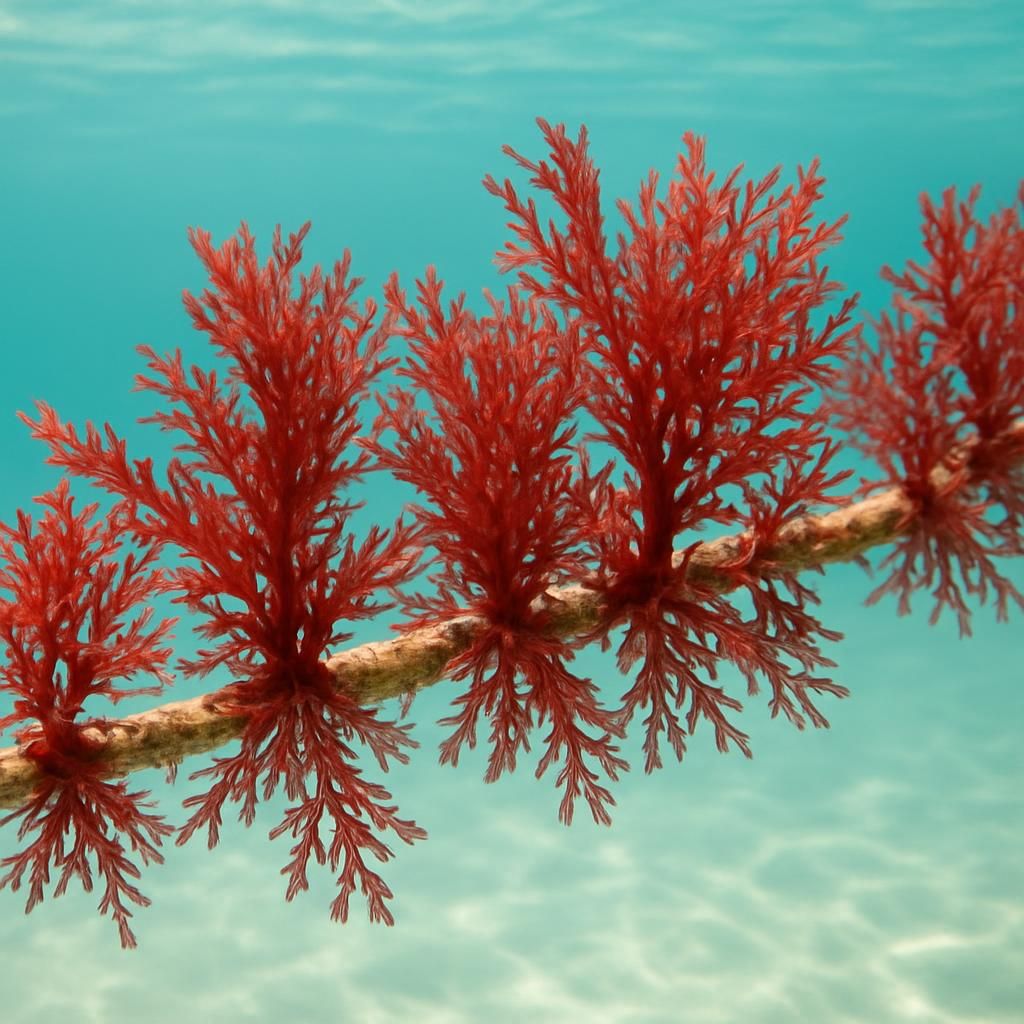
Introduction to Agar-Agar
Agar-agar is a natural polysaccharide obtained from select species of red algae. It forms a firm, thermo-reversible gel that remains stable at high temperatures, making it indispensable in confectionery, microbiology media, and vegan cuisine. Commercial production relies on both wild harvesting and controlled marine farming, with the latter offering consistent quality and sustainability.
Global demand continues to rise due to the clean-label movement and the expansion of plant-based products. Farmers who master the nuances of water quality, light regimes, and seasonal temperature swings can achieve premium pricing for high-gel-strength agar.
Botanical Profile of Agar-Agar
The primary commercial species belong to the genera Gelidium and Gracilaria. Gelidium amansii, native to the temperate coasts of East Asia, produces the highest gel strength (typically 700–900 g/cm²). Gracilaria species, such as G. verrucosa, are faster-growing but yield softer gels (300–500 g/cm²) and require different processing parameters.
These macroalgae lack true roots, stems, and leaves. Instead, they possess a thallus composed of branched, cartilaginous fronds anchored by a holdfast. Photosynthetic pigments include phycoerythrin, giving the characteristic reddish-purple hue. Life cycles alternate between diploid tetrasporophytes and haploid gametophytes, with spore release occurring in late spring.
Soil, pH, and Climate Requirements for Agar-Agar
Agar-agar cultivation occurs in marine environments rather than terrestrial soil. Optimal parameters are summarized below:
| Parameter | Ideal Range | Notes |
|---|---|---|
| Salinity | 30–35 ppt | Lower levels reduce gel strength |
| Temperature | 18–24 °C | Growth halts below 12 °C or above 28 °C |
| pH | 7.8–8.4 | Stable oceanic buffering |
| Light Intensity | 300–600 µmol photons m⁻² s⁻¹ | 12–14 h photoperiod optimal |
| Current/Water Flow | 0.1–0.3 m s⁻¹ | Prevents sedimentation and disease |
| Nutrient (N) | 0.5–2.0 mg L⁻¹ NO₃-N | Excess promotes epiphytes |
| Depth | 1–5 m | Deeper culture reduces UV stress |
Step-by-Step Planting & Propagation
Spore Collection: Mature tetrasporophytes are collected in late spring. Fronds are rinsed in sterile seawater and placed in aerated tanks at 20 °C under low light (50 µmol photons m⁻² s⁻¹) to induce spore release.
Settlement: Cleaned glass or PVC substrates are introduced. Spores settle within 24–48 hours; settlement density of 500–800 spores cm⁻² ensures uniform stands.
Nursery Phase: Seedlings are raised in 1,000 L tanks for 4–6 weeks. Daily water exchange of 300 % maintains nitrate at 1 mg L⁻¹ and prevents diatom blooms.
Outplanting: Seedlings measuring 3–5 cm are transferred to submerged long-line systems or raft modules spaced 30 cm apart. Lines are suspended 1.5 m below the surface.
Vegetative Propagation (optional): Healthy fronds can be fragmented into 10 cm cuttings and tied to ropes for faster biomass increase, bypassing the spore stage.
Care & Maintenance regimes for Agar-Agar
Maintaining consistent growth requires scheduled interventions:
| Activity | Frequency | Details |
|---|---|---|
| Water Exchange | Daily 200–300 % | Maintains nutrients and oxygen; automated pumps recommended |
| Fertilization | Weekly | 1 mg L⁻¹ KNO₃ + 0.1 mg L⁻¹ KH₂PO₄ applied at dusk to minimize epiphytes |
| Pruning/Thinning | Every 3 weeks | Remove 20 % oldest fronds to improve light penetration and reduce disease |
| pH Monitoring | Continuous | Target 8.0–8.2; adjust with CO₂ injection if below 7.7 |
| Biofouling Control | Bi-weekly | Gentle brushing of lines; introduce grazing snails (Littorina spp.) |
Pests, Diseases & Organic Management
Epiphytic diatoms and filamentous green algae compete for light and nutrients. Weekly brushing combined with reduced nitrogen fertilization keeps fouling below 5 % cover.
Pythium species can cause thallus rot in stagnant water; increasing flow rate to 0.25 m s⁻¹ and maintaining salinity above 32 ppt effectively suppresses outbreaks.
Herbivorous fish such as rabbitfish and parrotfish graze young fronds. Fine-mesh predator nets (1 cm) provide physical exclusion while permitting water exchange.
Organic-approved copper-based algaecides at 0.2 ppm can be used sparingly during peak fouling periods but must be discontinued 14 days before harvest.
Harvesting, Curing & Optimal Storage
Harvest occurs 90–120 days after outplanting when frond length reaches 40–60 cm. Fronds are cut 5 cm above the holdfast to allow regrowth. Immediate rinsing in fresh seawater removes salt crystals.
Curing involves sun-drying on elevated racks for 3–5 days until moisture content drops below 15 %. Dried sheets are then pressed into 25 kg bales and stored at 15 °C and 60 % RH. Under these conditions gel strength remains stable for 24 months.
Rehydration tests should be performed quarterly; gel strength loss greater than 10 % indicates improper storage and triggers lot rejection.
Companion Planting for Agar-Agar
While traditional companion planting does not apply to marine crops, co-cultivation with filter-feeding bivalves such as mussels enhances water clarity and provides natural nutrient recycling. Mussel lines suspended 2 m below agar lines reduce suspended solids by 30–40 %.
Polyculture with Oyster Mushroom production on land can utilize agar processing waste (spent fronds) as a substrate supplement, closing the nutrient loop and generating additional revenue.
For land-based operations seeking crop diversification, integrating agar processing effluent into hydroponic systems growing Thai Basil has shown 15 % yield increases due to residual minerals.