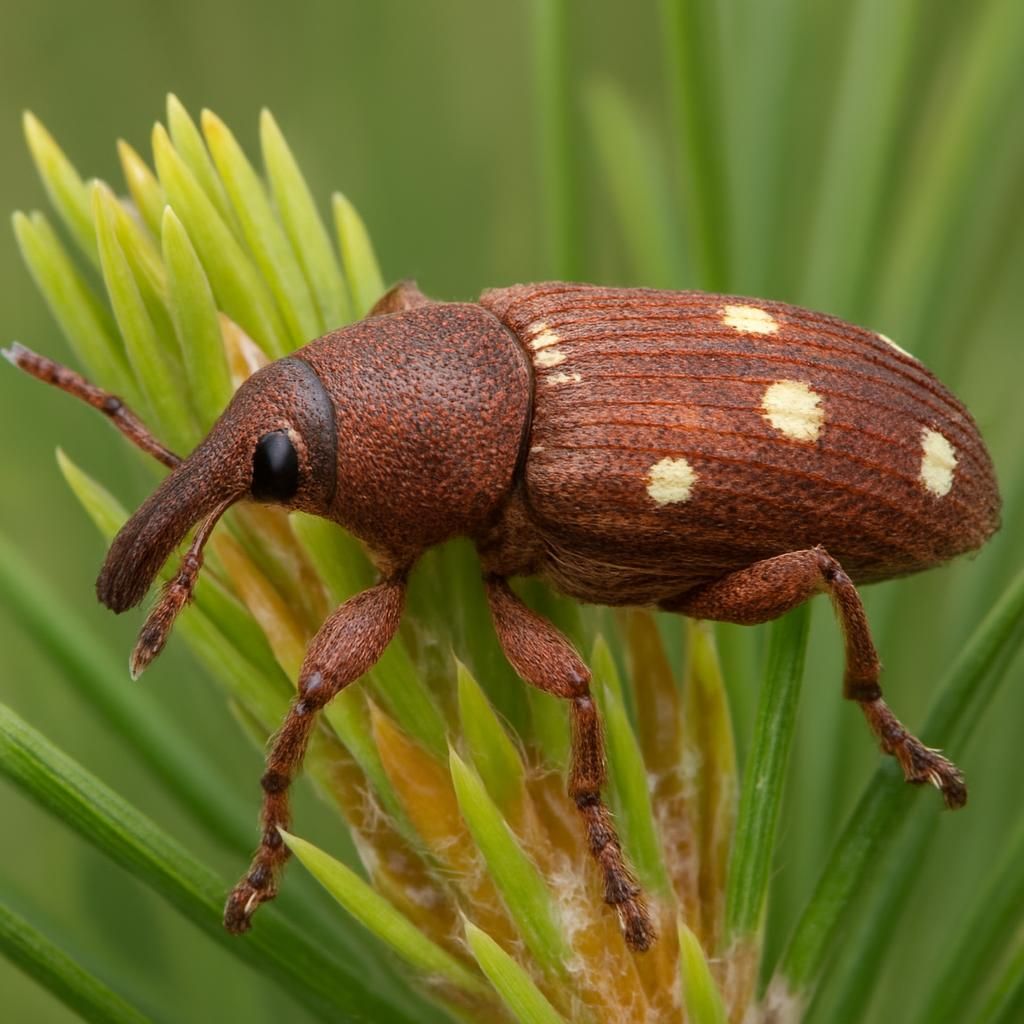
Introduction to white pine weevil
The white pine weevil (Pissodes strobi) is a major pest of coniferous trees in North America, with eastern white pine (Pinus strobus) being the most severely affected host. Adult weevils are small, reddish-brown beetles approximately 4–6 mm long with distinctive white spots on their elytra. This pest overwinters as adults in the duff layer and emerges in early spring to attack the terminal leaders of young trees, leading to characteristic flagging and crooking of the main stem.
Damage from the white pine weevil can significantly reduce timber value and aesthetic quality in Christmas tree plantations, reforestation sites, and landscape plantings. Infestations are most common on trees 1–6 meters tall growing in open, sunny conditions. Integrated management that addresses both adult feeding and larval development provides the best long-term control.
Identifying Symptoms & Damage
Early detection relies on recognizing leader flagging, where the current-year terminal shoot wilts, turns brown, and dies during late spring or early summer. Resin droplets often appear at feeding and oviposition sites on the bark. As larvae tunnel downward through the phloem and cambium, the leader becomes girdled, resulting in a characteristic shepherd’s crook shape.
Secondary symptoms include multiple competing laterals assuming dominance, creating a bushy or multi-stemmed appearance. Wood quality declines due to pith feeding and associated staining. In severe cases, repeated attacks can kill the tree outright or render it unsuitable for high-value lumber or veneer.
Lifecycle and Progression of white pine weevil (MUST INCLUDE A MARKDOWN TABLE OF LIFECYCLE STAGES)
The white pine weevil completes one generation per year in most regions. Adults emerge from overwintering sites when daytime temperatures reach approximately 10–15 °C, typically between March and May depending on latitude. Females chew small punctures in the bark of the previous year’s leader and deposit eggs. Larvae hatch within 7–10 days and feed downward, completing development by early summer. Pupation occurs in chip cocoons within the bark, and new adults emerge in July–August before seeking overwintering sites.
| Stage | Timing | Description | Key Activity |
|---|---|---|---|
| Overwintering Adult | October–March | Adults hibernate in leaf litter or soil duff near host trees | Survival and spring emergence |
| Adult Emergence & Feeding | March–May | Adults feed on bark and terminal buds; mating occurs | Oviposition begins |
| Egg | April–June | 1–5 eggs laid per puncture in terminal leader | Hatching in 7–14 days |
| Larva | May–July | White, legless grubs tunnel through phloem and xylem | Girdling and leader death |
| Pupa | June–August | Pupation inside chip cocoons within bark | Transformation to adult |
| New Adult | July–September | Teneral adults feed briefly before entering diapause | Dispersal and overwintering |
Environmental Triggers & Risk Factors
High-risk conditions include open-grown plantations with full sun exposure, poor soil fertility, and drought stress that reduces tree vigor. Young trees 3–15 years old with leaders 0.5–2 cm in diameter are most susceptible. Sites with heavy grass competition or recent thinning that increases light penetration often experience higher attack rates.
Temperature plays a critical role: warm springs accelerate adult emergence and egg-laying, while cool, wet weather can delay activity. Elevation and aspect also influence populations, with south-facing slopes warming earlier and supporting earlier infestations.
Organic Control & Treatment Plans (MUST INCLUDE A MARKDOWN TABLE OF TREATMENT OPTIONS AND FREQUENCIES)
Organic management emphasizes prevention and cultural practices supplemented by targeted interventions. Remove and destroy infested leaders before adult emergence to break the lifecycle. Apply organic-approved insecticides such as neem oil or spinosad during the adult emergence window when 50 % of terminal buds show feeding damage.
| Treatment Option | Active Ingredient / Method | Application Window | Frequency | Notes |
|---|---|---|---|---|
| Leader Pruning & Destruction | Manual removal below damage zone | April–June | Once per infestation | Bag and burn or chip material |
| Neem Oil Spray | Azadirachtin 0.5–1 % | Adult emergence (spring) | Every 7–10 days for 3 apps | Target terminal leaders thoroughly |
| Spinosad Spray | Spinosad 0.5–1 L/ha | Adult feeding period | 2–3 applications | Use during dry weather; rotate modes |
| Beneficial Nematodes | Steinernema carpocapsae | Larval stage (soil drench) | Once in early summer | Apply to duff layer around base |
| Kaolin Clay Barrier | Surround WP | Pre-emergence (early spring) | Reapply after heavy rain | Creates physical deterrent on terminals |
| Mulch & Weed Control | Organic mulch 5–8 cm depth | Year-round | Maintain annually | Reduces adult overwintering sites |
Preventing white pine weevil in the Future
Planting resistant or less-preferred species such as Norway spruce or Scots pine in high-risk areas reduces overall susceptibility. Maintain vigorous tree growth through balanced fertilization and irrigation to improve natural resistance. Avoid excessive spacing that creates open conditions favoring weevil attack.
Monitor plantations weekly from March through June using visual scouting and pheromone traps. Implement a 3–5 year crop rotation with non-host species on severely infested sites. Retain lower branches on young trees to shade leaders and discourage adult oviposition.
Crops Most Affected by white pine weevil
While primarily a forest pest, the white pine weevil impacts several high-value conifer species used in Christmas tree production and reforestation. Eastern white pine is the preferred host, followed by jack pine, red pine, and Norway spruce. Other affected species include Douglas-fir, Sitka spruce, and blue spruce.
Damage to these crops results in reduced height growth, stem deformities, and loss of market grade. In landscape settings, repeated attacks on specimen trees can necessitate costly removals or corrective pruning.