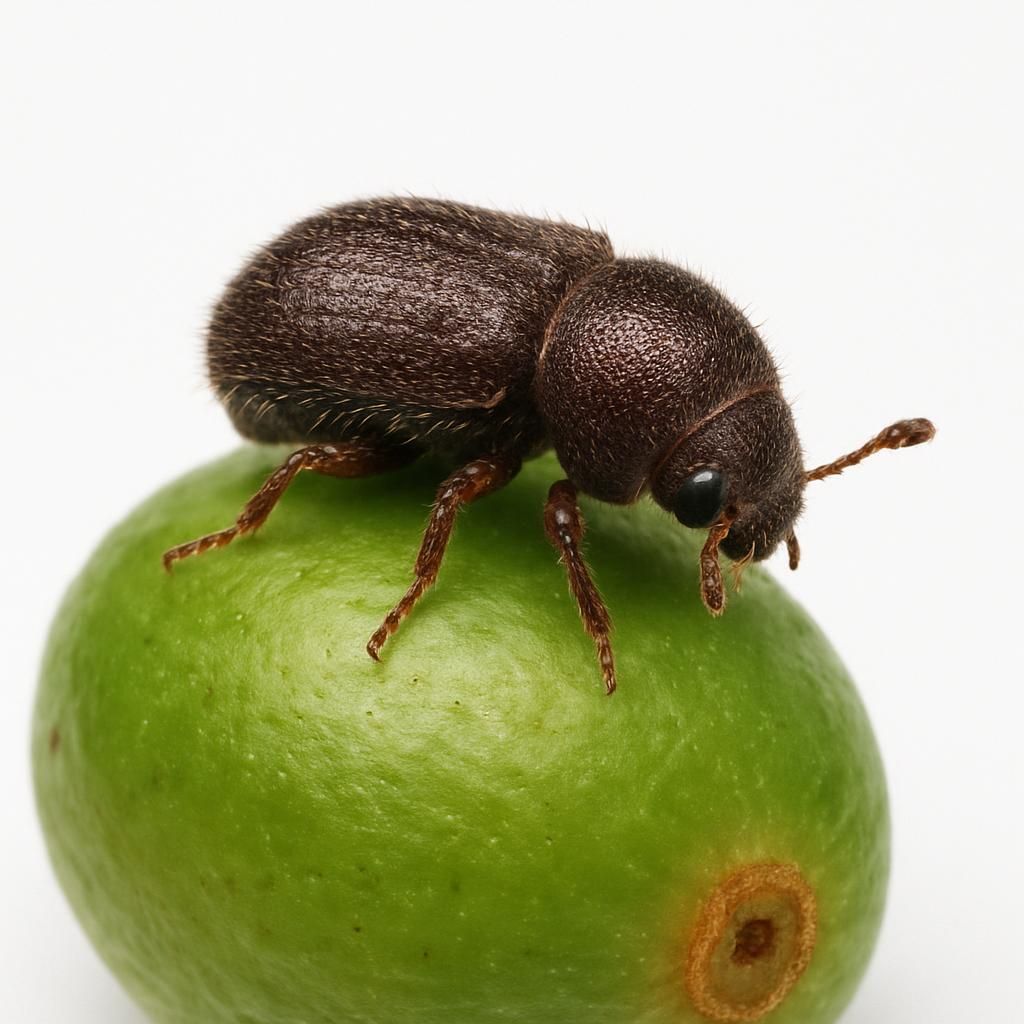
Introduction to Hypothenemus hampei
Hypothenemus hampei, better known as the coffee berry borer (CBB), is a small scolytid beetle that has become the single most destructive pest of Coffee production globally. Native to central Africa, it has spread to nearly every coffee-growing region, including Latin America, Asia, and the Pacific. Adult females measure just 1.5–2.0 mm and are capable of flying short distances or being carried on wind, clothing, or equipment. Once inside a berry, females lay eggs that hatch into larvae which feed exclusively on the endosperm, rendering beans unmarketable and severely reducing both yield and cup quality.
Because the pest completes most of its life cycle inside the berry, detection is difficult until damage is advanced. Losses can exceed 50 % in heavily infested plantations when control measures are absent. The economic impact is compounded by increased harvesting costs, the need for rigorous sanitation, and potential rejection of shipments due to live insects or quality defects. Understanding the biology, environmental triggers, and integrated management options is essential for sustainable coffee production.
Identifying Symptoms & Damage
Early symptoms are subtle. Small entry holes (about 0.8–1 mm) appear near the apex or navel of green or ripening berries. A characteristic “C” or “D” shaped tunnel may be visible if the berry is sliced open. Frass (insect excrement) often accumulates at the hole entrance, appearing as a fine white powder. As larvae develop, the bean is hollowed out, leaving only the parchment and silver skin.
Advanced infestations show multiple exit holes, premature berry drop, and “broca” beans that are light, spongy, and lack the typical density. Secondary fungal infections frequently follow, producing off-flavors described as “earthy,” “musty,” or “phenolic.” In severe cases, entire clusters may be lost, and the cumulative effect across a farm can reduce marketable yield by 30–80 %.
Lifecycle and Progression of Hypothenemus hampei (MUST INCLUDE A MARKDOWN TABLE OF LIFECYCLE STAGES)
The coffee berry borer exhibits a holometabolous life cycle completed almost entirely inside the berry. Females bore an entry tunnel, mate inside or near the entrance, and lay 30–50 eggs over several weeks. Larvae feed for 10–20 days before pupating; adults emerge ready to infest new berries or survive in fallen fruit.
| Stage | Duration (approx.) | Key Characteristics | Location inside berry |\n|-------------|--------------------|----------------------------------------------|--------------------------------|\n| Egg | 5–9 days | Oval, translucent, 0.3 mm | Clustered near entry tunnel |\n| Larva | 10–20 days | White, legless, C-shaped, 3 instars | Tunnels through endosperm |\n| Pupa | 4–9 days | Exarate, initially white then darkening | Within larval gallery |\n| Adult | 3–5 months | Dark brown/black, 1.5–2.0 mm, females flight-capable | Emerge through exit holes |
Temperature strongly influences development; optimal range is 23–28 °C with development slowing below 18 °C or above 32 °C. The entire cycle can be completed in 25–35 days under ideal conditions, allowing 3–5 generations per season in tropical zones.
Environmental Triggers & Risk Factors
Several abiotic and biotic factors increase outbreak risk. High humidity (>70 % RH) and temperatures between 22–28 °C accelerate reproduction. Prolonged dry spells followed by rain can trigger mass emergence as females seek moisture. Overripe or fallen berries left on the ground serve as reservoirs, enabling carry-over between seasons. Shade-grown systems with dense canopies often experience higher humidity and lower temperatures, favoring the pest, while poorly managed pruning leads to excessive humidity at the berry zone.
Altitude also plays a role: farms between 600–1200 m above sea level in equatorial regions typically report the highest incidence. Poor sanitation after harvest, inadequate trap deployment, and delayed harvesting further amplify populations. Farms near neighboring infested plantations face constant re-infestation pressure via wind or human movement.
Organic Control & Treatment Plans (MUST INCLUDE A MARKDOWN TABLE OF TREATMENT OPTIONS AND FREQUENCIES)
Organic management of Hypothenemus hampei relies on sanitation, biological control agents, and targeted attractants. Cultural practices such as strip-picking, frequent collection of fallen berries, and solarization of infested material are foundational. Releases of the parasitoid wasp Cephalonomia stephanoderis and the entomopathogenic fungus Beauveria bassiana provide season-long suppression when timed correctly.
| Treatment Option | Active Ingredient / Agent | Application Frequency | Notes / Best Practices |\n|-----------------------------------|--------------------------------------------|----------------------------------------|-----------------------------------------------------|\n| Sanitation (collection & destruction) | Manual or mechanical removal of all ripe/fallen berries | Weekly during harvest peak; bi-weekly off-season | Bury or solarize collected material for 48 h |\n| Beauveria bassiana spray | Commercial mycoinsecticide (strain GHA or similar) | Every 2–3 weeks at first detection; reapply after heavy rain | Apply in late afternoon; maintain >70 % RH for 48 h |\n| Cephalonomia stephanoderis release | Adult parasitoid wasps | 2–3 releases per season (early and mid-season) | 20–30 wasps per infested tree; protect from ants |\n| Alcohol-based traps (broca traps) | 1:1 ethanol:methanol + water + detergent | Check and refresh weekly | Place 1 trap per 100 trees at 1.2 m height |\n| Cultural: strip picking & pruning | Labor-intensive complete harvest | 2–3 complete passes at 10–14 day intervals | Reduces breeding sites dramatically |
Integration of these tactics typically reduces infestation below the 5 % economic threshold within two seasons when implemented consistently.
Preventing Hypothenemus hampei in the Future
Prevention begins with rigorous post-harvest sanitation. All berries must be removed from trees and the ground; any remaining fruit should be buried at least 30 cm deep or solarized under clear plastic for several days. Maintaining a 3–4 month “berry-free” period between seasons starves emerging adults. Pruning to open the canopy improves airflow and reduces humidity around berries. Establishing windbreaks and buffer zones with non-host plants can limit wind-borne dispersal from neighboring farms.
Monitoring programs using alcohol traps should be maintained year-round, with action thresholds set at 2–3 beetles per trap per week. Training harvest crews to recognize early entry holes and immediately report hotspots improves rapid response. Long-term resilience also benefits from planting resistant or tolerant varieties where available and from adopting The Overlooked Art of Crop Rotation for Small Farm Resilience principles adapted to perennial coffee systems.
Crops Most Affected by Hypothenemus hampei
While coffee is the primary host, Hypothenemus hampei has been recorded on a limited number of other hosts in the Rubiaceae family. In commercial agriculture, however, damage is overwhelmingly concentrated on Coffee. Occasional reports exist on wild relatives such as certain Psychotria species, but these do not reach economic significance. No other major global crops suffer comparable losses, making targeted coffee-specific IPM the most efficient control strategy.